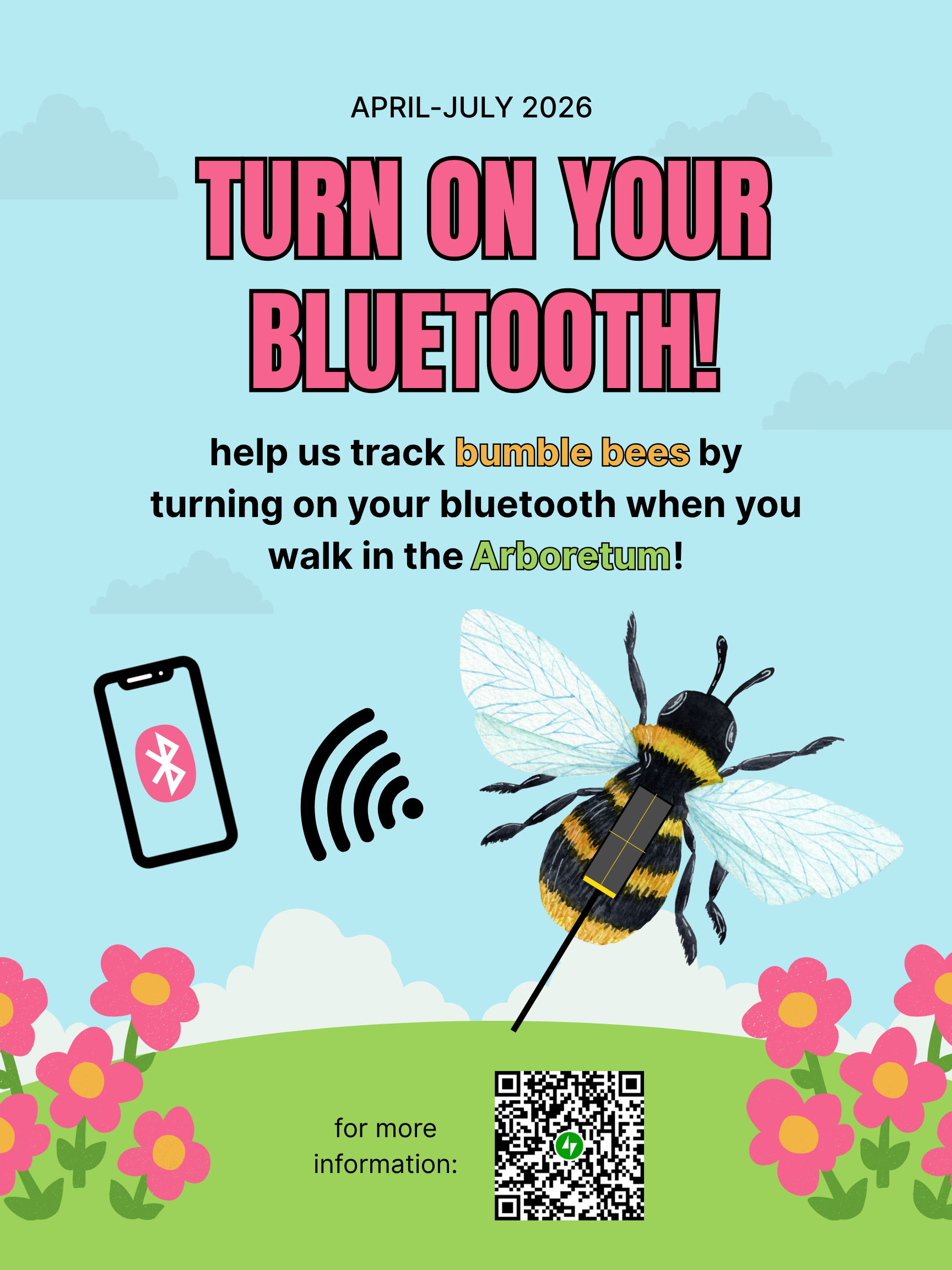
Using newly developed Blū+ radiotransmitters from Cellular Tracking Technologies, we will track common eastern bumblebee (Bombus impatiens) queens in the spring to gain insight into their movement behaviour while searching for nesting sites. Operating at a frequency of 2.4 GHz, these transmitters function similarly to Apple AirTags by using Bluetooth to connect to nearby cellular-enabled devices, allowing signals to be relayed through cellular networks and resulting in a high number of detections. In addition, Blū+ radiotransmitters are solar-powered and extremely lightweight (0.06 g), making them well suited for tracking flying insects. These transmitters were successfully used to track monarchs to their overwintering grounds in fall 2025, but have not yet been tested on bumble bees.
The goal of this project is to test whether these transmitters can be effectively used on bumble bees. They are expected to be sufficiently lightweight, as heavier tags have previously been used to track queen bumble bees. However, challenges may arise from the fact that bumble bees nest underground; the transmitter antenna may interfere with underground movements, and exposure to moisture (e.g., morning dew) and soil debris may affect data collection. In addition, because the radiotransmitters are solar-powered and do not contain a battery, their performance may be limited when bees are underground for extended periods.
The second goal of the project is to determine whether captive bees behave similarly to wild bees. Both captive and wild queens will be tagged and released in the Arboretum, and, if the data allow, differences in their movements will be analyzed.
Because Blū+ radiotransmitters function like Apple AirTags, we encourage everyone walking in the Arboretum to turn on Bluetooth on their iPhones. This is the easiest way to support the research!
For any questions or comments about this project, please contact Marianne Goulet (mgoule02@uoguelph.ca).
 Nigel Raine Lab